

I have been following alternative asset managers for a while now, and even though they are excellent businesses, their stocks seem to be struggling quite a bit.
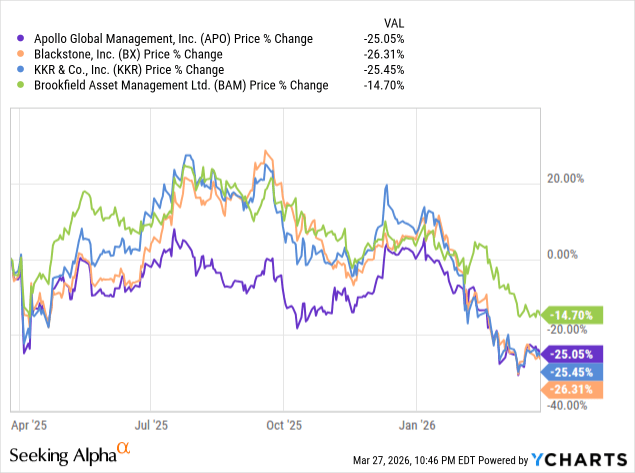
Apollo Global Management (NYSE: APO 0.00%↑ ), which is one of the largest players in private credit, despite strong inflows and record AUM last year, saw its stock go down significantly. The same happened with its peers like Blackstone (BX), Brookfield Asset Management (BAM) and KKR & Co. (KKR). And this is not caused by fundamentals but due to worries about the private credit market and, more recently, due to increased redemptions from investors from private credit funds.
In my opinion, these headwinds are not going to last for an extended period, and this decline in stock price creates an attractive opportunity to buy Apollo near its 52-week lows.
Investment Thesis
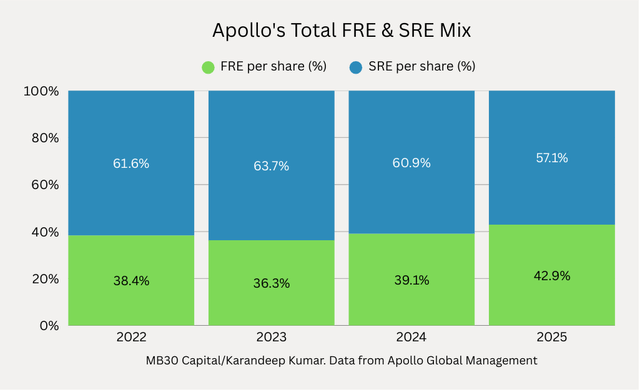
My conviction in Apollo comes from two things. First is that, for the most part, Apollo has been valued at lower multiples than its peers because its earnings mix was dominated by SRE (Spread-Related Earnings) rather than the Fee-Related Earnings, which are considered to be more predictable and sticky. But the important thing to note in Apollo’s case is that the earnings mix is changing.
If we look back at the past few years, FRE has gone up from 36.3% in 2023 to around 43% in 2025 of the total FRE & SRE mix, and this is a trend that I expect to continue. So, once we have an earnings mix that is dominated by FRE, I strongly believe that Apollo’s multiples will expand and be more in line with what we see with its peers.
Secondly, because of weak sentiment towards private credit, Apollo, which was already priced lower than its peers, now trades at even lower multiples. My projections suggest that Apollo’s stock is about 28% undervalued compared to its intrinsic value today, which provides us enough margin of safety to navigate through the short-term headwinds that the company is facing today.
Valuation
At the current earnings mix (43% FRE & 57% SRE), the multiple is around 11.4x. Total SRE and FRE today is $9.50, and the current stock price is $108.42.
So, as the mix shifts more towards FRE, I think it is fair to expect that the multiples will expand, and Apollo will likely trade at a 17-19x multiple or higher. For our valuation, I’ll go with a 17x multiple, which I think would be quite reasonable for the company.
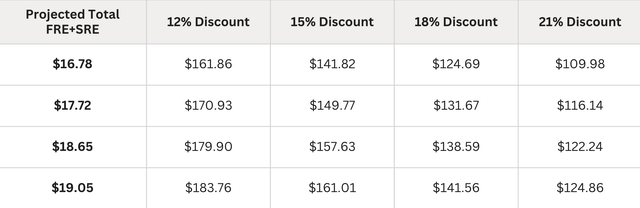
Even in the most conservative scenario for Apollo, where its Total FRE & SRE grows by 12% every year for the next five years, the fair value at an 18% discount rate is close to $125.
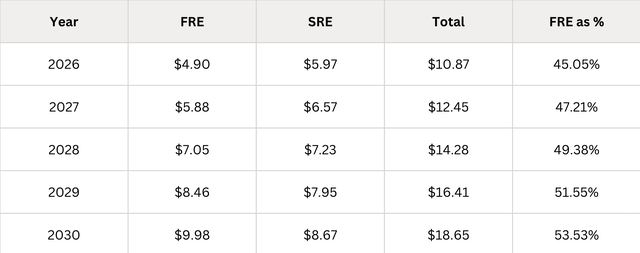
But if we look at our base scenario of $17.72 earnings in 2030 (13% yearly growth), the fair value at a 15% discount rate is closer to $150. Put another way, the stock is trading approximately 28% below its fair value according to our estimates.
FY2025 Results
For the full year 2025, Apollo’s Fee-Related Earnings increased by 23% compared to 2024. The FRE Margins were also stable at 56% for both years. Total Assets Under Management and Fee-Generating AUM also went up by 25% and reached $938 billion and $709 billion, respectively. For most metrics, Apollo delivered double-digit growth.
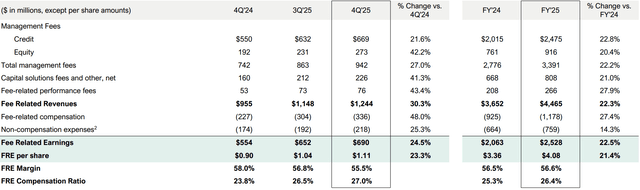
On the Spread Related Earnings side, the growth, however, was 4.2% with the Net Spread decreasing 15 basis points from 1.38% in 2024 to 1.23% in 2025. This compression could be attributed to the increased cost of funds, which went up by 31% YoY, and a 20% increase in interest and other financing costs.
Inflows & Dry Powder
Total inflows for Apollo in 2025 were $228 billion, originations totalled $309 billion, and total deployment was $386 billion. Year-end dry powder was $73 billion, of which $42 billion is for Private Credit and $30 billion is for Private Equity strategies.
All-in-all, I think it’s fair to say that 2025 was a really good year for Apollo. Despite widespread concerns, inflows were strong, and the business grew double-digits.
What’s Next?
I think the headwinds that alternative asset managers are facing today with regard to private credit are short-term in nature and do not impact the sustainability and growth of the long-term business model. Not only that, I think that the Big 4 (Blackstone, Brookfield, KKR & Apollo) will actually benefit from consolidation in this space as smaller players will likely struggle to regain investor confidence and, as a result, raise more funds. It is also important to note that the Big 4 have a record dry powder at their disposal, and this decline in private credit valuation might actually allow them to buy out funds that might be fundamentally strong, but are going through sentiment problems at very low prices.
Secondly, as we are seeing increased spending on AI infrastructure, I strongly believe that lenders like Apollo will benefit tremendously from this boom. While some of the buildout is going to get funded through more conventional forms of debt like public market bonds, I see private credit playing a more prominent role in this buildout going forward. Apollo’s $3.5 billion deal with xAI in January is one such example, and I think we will continue to see more deals like this in future.
Risks
While I do believe that over time firms like Apollo will do just fine, the disruption caused by AI is indeed real, which has resulted in valuations of software companies plummeting significantly both in the public markets and those in Private funds. As a result, the Loan-to-Value numbers have gone up significantly, and this has resulted in considerable markdown on valuations and has caused concerns about many borrowers’ ability to pay back.
But I think it is also important to note that while some software companies might struggle to adapt and survive, not every company is created equal. Also, the seniority of the debt itself will affect the real impact of defaults on the lender, which varies from firm to firm and fund to fund.
If I talk about Apollo specifically, while ADS (Apollo Debt Solutions) has mid-teens exposure to software, it is “100% senior secured, first lien, no PIK, no ARR“. It is also important to put things into perspective. In the most recent earnings call, the company confirmed that its exposure to this segment is less than 2% of its total AUM, with less than 1% exposure on the Private Equity side and the Athene balance sheet, which means the actual exposure and impact on the overall business is way lower than what the market is expecting.
Apart from AI disruption, another risk that I see is increased competition from asset managers like BlackRock and firms like Morgan Stanley and Goldman Sachs, who are trying to increase their presence in the alternatives space, and will likely benefit from their scale and existing client base. But I think we need to keep in mind that the alternative markets are growing every year, and even with an increasing number of big players entering the market, there is enough room for Apollo to grow its AUM and achieve a 12-15% annual growth in the total FRE & SRE.
The Bottom Line
To sum up, I’d say that Apollo is an excellent business which, at present, is facing headwinds that, in my opinion, are short-term. Due to these headwinds, its valuation has come down significantly, and it has created a 28% gap between its current price and intrinsic value.
I assign Apollo a Strong Buy rating and a price target of $150. I think there is sufficient margin of safety to get through current headwinds, and the long-term growth prospects remain intact.