

When I last wrote about Fairfax (FRFHF), my thesis was based on its Q3 results, as the Q4 and full-year 2025 results were not yet released. But now that we have the results, I think it’s a good time to revisit that thesis and see what has changed, and if Fairfax still makes a case for a Strong Buy.
FY2025 Highlights
To begin with, the core highlights of 2025 results were EPS, which grew 33.15% YoY to $213.78, and per-share book value, which grew 20.5% from $1,059.60 in 2024 to $1,260.19. No doubt, both of these key metrics grew at an astounding rate. But there is more to the story.
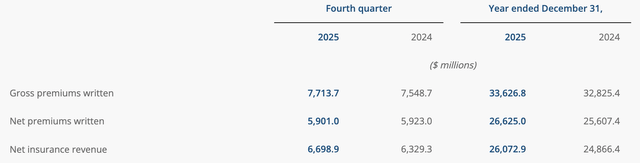
While GPW (Gross premiums written) grew by 2.3% and NPW (Net premiums written) grew by 3.9% for the full year 2025, operating income from P&C insurance and reinsurance actually went down about 9%. And this decline could be attributed primarily to the decline in earnings from the Global insurers and reinsurers segment, and a decrease in the share of profit of associates.
There are two things that caused this decline in the share of profit of associates. First, there was a $64.7 million loss that the company had from the Waterous Energy Fund III, and second, Peak achievement, whose earnings were included in this segment for most of 2024, was consolidated for the year 2025, which means earnings from Peak achievement are now included in ‘Operating Income - Non-insurance companies’.
I think it’s also important to mention that last year, the company had around $722 million in catastrophe losses from California wildfires, which ultimately affected operating earnings for the year.
Other than that, to Fairfax’s credit, the company managed its other insurance operating expenses really well, which were essentially flat year over year, and the combined ratio was 93% for the full year, a modest 30 basis point increase from 92.7% in 2024.
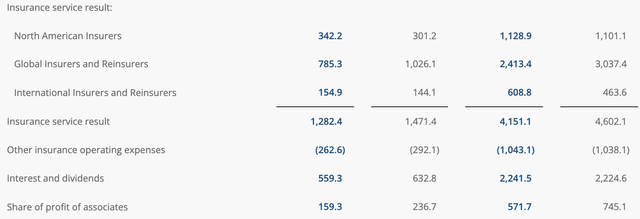
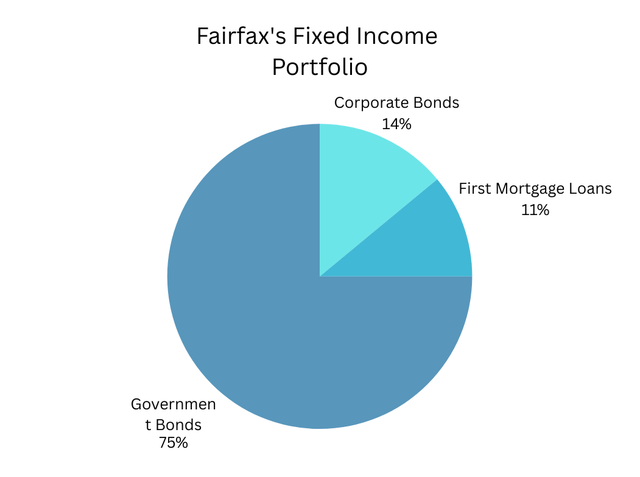
Interest and dividend income were also consistent with the 2024 numbers, which seem to strengthen management’s expectations to maintain this yield for the next few years. The composition of Fairfax’s fixed income portfolio is also quite reassuring, as shown in the picture below.
The Hidden Value
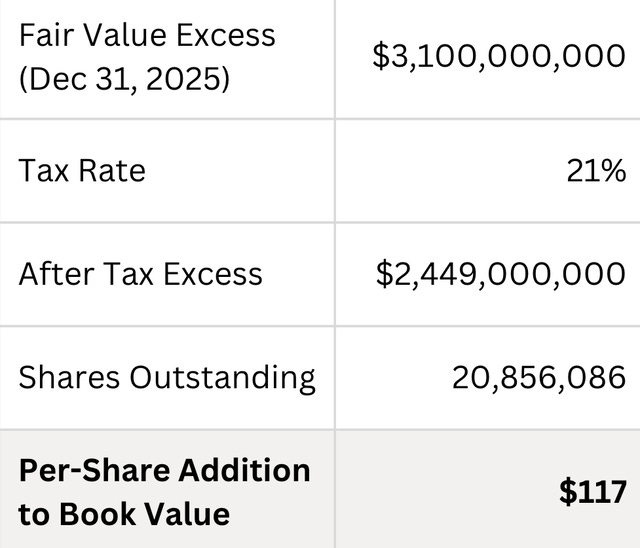
In 2025, Fairfax’s fair value excess over carrying value more than doubled compared to 2024, going up from $1.5 billion to $3.1 billion. Now, on a per-share basis, this would add around $148.6 (pre-tax) to the book value. But realistically, we need to factor in the taxes, since once the unrealized gains materialize, there will be tax liabilities as well.
So, for our calculation, we’ll assume a 21% tax rate (the actual rate for 2025 was 18%, and for 2024 was 24.4%).
As you can see from the calculations, we get an estimated after-tax addition of $117 to the per-share book value of $1260.19, which gives us an adjusted BVPS of $1377.19.
This means that the stock is trading at a relatively cheaper P/B multiple of 1.24x, compared to the 1.35x multiple that the actual BVPS gives us.
Valuation
Now, let’s look at Fairfax’s valuation from the Earnings per share perspective. We’ll use a normalized EPS using BVPS of $1260.19 and the average ROE of 15%, which leads us to an EPS of $189. We’ll use a 10x P/E multiple as that is a very reasonable multiple for a company like Fairfax, which has been consistently growing its book at an average rate of more than 15%.
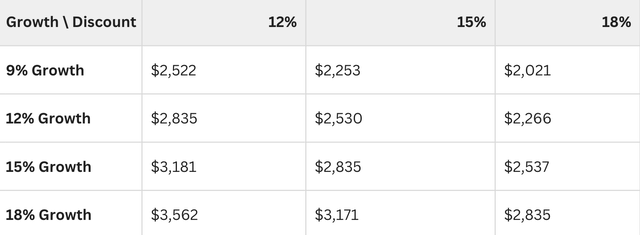
Now, what stands out to me is that, even in the most conservative scenario of 9% EPS growth over the next five years and an 18% discount rate, the intrinsic value of $2,021 is still much higher than Fairfax’s current share price of $ 1,706.
If we look at a more pragmatic base-case scenario of 12% EPS growth and a 15% discount rate, the $2530 intrinsic value suggests that, at current price levels, there is more than 48% upside and a considerable margin of safety if things don’t go as planned for a while.
Share buybacks
As discussed in my previous article, Fairfax prefers to return capital to shareholders by buying back its shares opportunistically and only when such purchases are highly accretive, rather than buying back at any price, or increasing the dividend significantly.
Throughout 2025, Fairfax bought back more than 1 million shares at an average price of $1,615. Not only that, since the beginning of this year, the company has continued to buy back its shares at an average price of $1,684, and has bought more than 130k shares. This again supports our thesis that at current prices, Fairfax is undervalued and presents an excellent entry point for long-term investors.
Risks
There are a few risks that I believe my readers should be aware of with regard to Fairfax. Firstly, particularly in North America, the insurance market is softening, which means that going forward, we may see a pullback in premiums written to protect underwriting profits rather than chasing unprofitable growth. Even though management expects to maintain underwriting profits of $1.5 billion for the foreseeable future, the market conditions can put some pressure on the businesses. However, since its insurance businesses in other parts of the world seem to be doing really well, I think growth in other countries would offset lower premiums in North America.
Secondly, the company is still dealing with losses from the Life insurance and Run-off insurance, which were around $213 million in 2025 and $92 million in 2024. I was in Fairfax’s earnings call yesterday, and when management was asked about a realistic end to these losses, there was no clear outlook on when they would stop. I don’t blame the management for not providing an expiry date for these claims, as they are indeed highly unpredictable. So, these losses are something to keep an eye on for at least a few more years.
Looking Ahead
While I expect the GPW and NPW written numbers to be a bit soft, I’m confident in Fairfax’s ability to continue achieving underwriting profits of $1.5 billion or more, and a combined ratio below 95%.
In its portfolio, the company is betting heavily on Under Armour. This was apparent from Fairfax’s conference call yesterday, where the management seemed to have a lot of faith in the company’s turnaround, especially after the return of founder/CEO Kevin Plank.
Then there is also the acquisition of Kennedy Wilson, in which Fairfax is participating along with other parties, which is expected to close in Q2 2026. This deal will give Fairfax the majority economic interest for $1.65 billion funding commitment. I think it is important to mention that the company will be operated by the KW Management Group and William McMorrow, who is the current Chairman and CEO as well. I believe that this move will meaningfully contribute to Fairfax’s earnings in the years ahead while keeping the same executives to run the company.
The Bottom Line
To sum up, I’d say that the Q4 and FY2025 results have strengthened the case for a Strong Buy rating for the company. The EPS growth and consistent BVPS growth are extraordinary, but this strong performance doesn’t reflect in its valuation at all.
The company is trading at a considerable discount to its fair value based on my calculations, and there is more than enough margin of safety in the face of short-term headwinds. I would consider any non-company-specific pullbacks caused by sector-wide sentiment as an opportunity to add this company to the portfolio for long-term compounding.
I therefore maintain a STRONG BUY rating after the FY2025 results.