

When I first started covering the BNPL (Buy Now, Pay Later) company Sezzle (NASDAQ: SEZL) in January, I assigned it a Strong Buy rating based on its fundamentals. Since then, the stock performance has been all over the place.
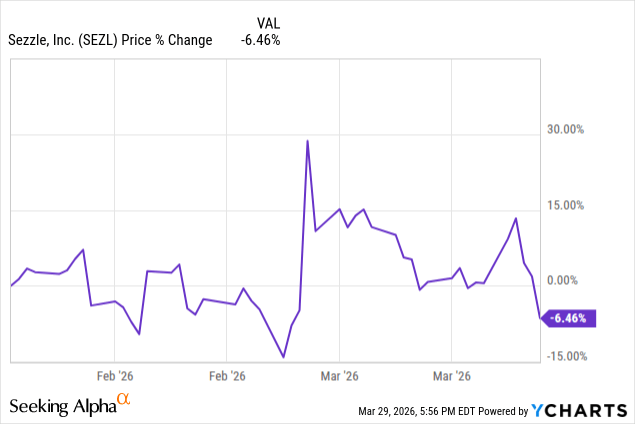
After the Q4 and FY2025 results announcement on Feb 25, the market responded quite positively, and the stock went up 35% the next day and almost reached $85. However, the sentiment started to erode again, and the stock now trades more than 6% below the price I initially recommended it at.
So, in this article, my goal is to analyze Sezzle’s fundamentals using its FY2025 results, and assess whether my original thesis still holds up and how I’m approaching this decline.
FY2025 Results
Before I get to factors that are putting downward pressure on the stock, let’s quickly discuss Sezzle’s performance for the full year 2025.
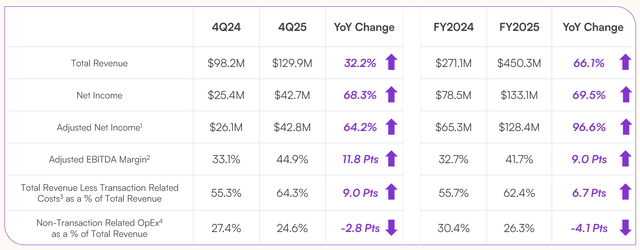
If we look at the top-line growth, Sezzle’s yearly revenues increased by 66.1% in 2025, 110 basis points higher than the company’s guided range of 60-65%. GMV (Gross Merchandise Volume) increased 55.1% from $2.54 billion to $3.94 billion.
Net income also went up by 69.5%, whereas adjusted net income almost doubled. Not only that, but the Adjusted EBITDA margins also improved from 32.7% in 2024 to 41.7% in 2025.
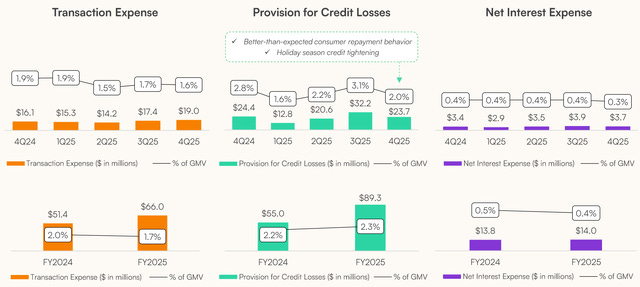
If we look at the expense side, the Transaction Expense as a % of GMV shrank from 2.0% in FY2024 to 1.7% in FY2025. Similarly, Net Interest Expense also decreased from 0.5% of GMV to 0.4%.
However, even though Provision for Credit Losses was down in Q425 (2.0% vs 2.8% in Q424), for the full year, there was a modest increase in provisions, and the percentage increased from 2.2% to 2.3%. But, it is important to note that it is still below the targeted range of 2.5% to 3%, and Sezzle’s higher take rate than its peers compensates for the higher provisions than its competitors.
An often-ignored and underappreciated advantage
I was going through Sezzle’s 2025 10-K form, and I came across this section about DSIP, which I found quite interesting. So, one of the major costs for a company like Sezzle is the cost of funds, and reducing that cost benefits the bottom line tremendously. While yes, you could and should try to negotiate better terms with the lenders for a lower interest rate, Sezzle took it a step further, which is something that is not often talked about.
So, the company has a DSIP, which stands for Delayed Settlement Incentive Program. What it essentially does is that instead of merchants choosing to settle payments from Sezzle immediately, they have the choice to defer those settlements to a later date and get paid interest on the balance.
Now, for merchants, this is like having a high-yield savings account that pays between 4% to 4.5% interest with some ‘cap on withdrawals’ (up to 250k on demand per week) and for Sezzle, this is a low-cost source of funds compared to the line of credit, where the company has to pay around 11% interest.
In 2025, the DSIP balance was close to $42 million, where the company effectively paid 4.12% interest, whereas the balance of LoC was $141.3 million with about 600 basis points higher interest. In my opinion, Sezzle’s DSIP is a really smart way of reducing interest expenses while increasing access to funds, and if the company continues to scale this program, the bottom-line benefits will be significant, and this would give it an edge over its competitors, who, to the best of my knowledge, don’t have a similar program in place.
Stock Performance
While the market reaction to Sezzle’s FY2025 results was very positive and the stock went up significantly, the stock price has fallen considerably since then. I think it’s quite obvious that this has less to do with the actual fundamentals and more with the macroeconomic environment. The ongoing conflict with Iran has once again fueled worries about inflation and reduced the probabilities of rate cuts this year. Due to concerns about the weakening of the economy, the overall stock market is under pressure, with consumer-facing stocks like Sezzle taking an even bigger hit.
In my opinion, Sezzle’s fundamentals remain solid, which gives me the confidence to increase my position in the company, and that’s what I’ve been doing recently.
Valuation
If we look at Sezzle’s valuation, then it is trading at a 17x multiple of its adjusted net income of $3.59 per share. On a forward basis, it is trading at just a 13x multiple. For a company that is guiding 25-30% top-line growth and about 31% growth in per-share adjusted income for 2026, I think the market is being overly skeptical in giving Sezzle such low multiples.
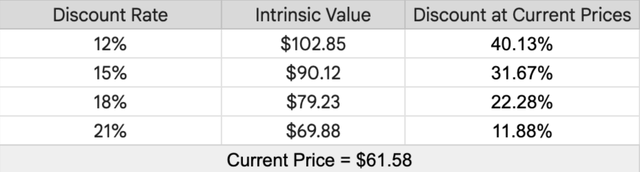
For our projections, I have taken management’s guided per-share adjusted income of $4.70 as the starting point. We’ll assume that the growth decelerates gradually during our five-year forecast period. At a multiple of 18x, which I sincerely believe is quite reasonable, our projection-end valuation is around $181.
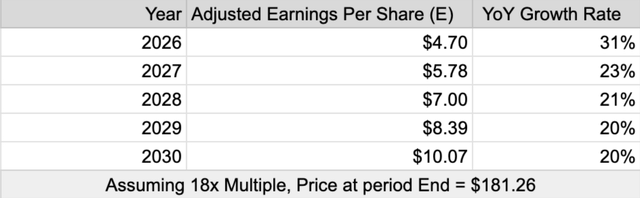
Even at a very high discount-rate of 21%, the stock is trading 12% below its fair value. However, if we look at our mid-point discount rate of 15%, the gap between fair value and current price widens to around 32%. I think at current valuations, there is a lot of upside and enough compensation to hold through the volatility.
Looking Ahead
Sezzle recently announced that it is venturing into providing wireless services with Sezzle Mobile, and the likely logic behind this is the lower likelihood of a subscriber changing their cellular provider on a regular basis, and as a result, they will likely stick with Sezzle for longer and opt in for other services that the company provides. This, I think, is fair enough. However, I also think that Sezzle’s ability to convert Sezzle Mobile customers into Sezzle Anywhere or Sezzle Premium customers will considerably influence the overall impact this new venture would have on growth and profitability.
I think it’s also worth mentioning that Sezzle is planning to expand into longer-term lending in addition to pay-in-4 and pay-in-6. Even though there is no guarantee whether it will actually materialize or not, Sezzle’s 10K report does mention that the company is looking into getting its own ILC (industrial loan company) bank charter, which would be a structural shift for the company and open doors to more opportunities.
If we look at the overall direction in which Sezzle is heading, then it’s apparent that the company doesn’t just want to be a BNPL provider but rather a full-stack finance and budgeting platform that also provides features like price comparisons, receipt scanning, browser extensions, and agentic commerce in future.
Risks
I think the most prominent risk for Sezzle is the risk of delinquency rates increasing if the economy weakens. The geopolitical environment has created a lot of uncertainty currently, which is why most investors are looking skeptically at not just companies like Sezzle but also the broader market.
But it is also important to consider that the ‘loans’ that Sezzle provides are short-term in nature, and there is flexibility for the company to tighten its underwriting if it sees unfavourable developments in the market. While doing so will likely temper short-term growth, I think the longer-term story and attractiveness of the company remain intact.
The other risk that I see relates to regulations. I think as the BNPL industry continues to expand, we’ll see more regulatory scrutiny in the industry, which might lead to higher compliance costs and impact the way companies in this industry work.
The Bottom Line
To sum up, I’d say that Sezzle has one of the best profitability profiles in its space, but its stock is under a lot of pressure due to macroeconomic factors. The BNPL industry is still in its early phases, and as more consumers adopt this payment method, Sezzle will continue to benefit. There is also an opportunity in the B2B BNPL space, should the company decide to tap into it.
So, after careful consideration, I reiterate my Strong Buy rating for Sezzle. I like the direction the company is heading in, plus the valuation at these levels is highly attractive to deliver a solid payoff once the macro pressures fade.